
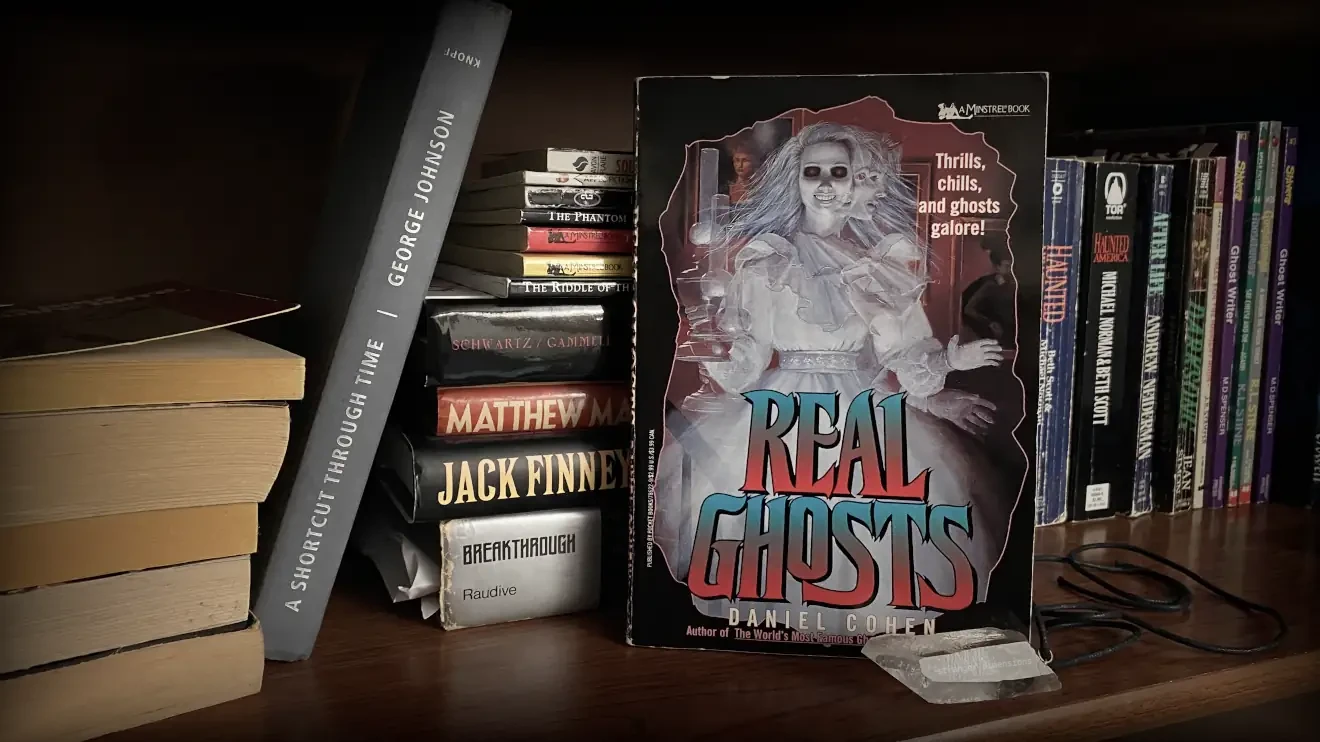
My copy of Real Ghosts up there has seen better days. Originally published in 1977 by Pocket Books, then reprinted in 1992 by Minstrel, this book fell into my hands in the early 90s, probably at a Scholastic Book Fair. It’s been a while.
That ghost lady on the front is pretty creepy, right? Glowing red eyes. I’ve had night terrors that look like her. From the cover, you might expect a pretty standard collection of ghost stories. There are only 122 pages, after all, and maybe eight of those are boilerplate. What more could be going on inside this thing?
The book is damaged, but let’s crack it open.
“It does not mean that all ghostly events are true…”
If you don’t know who Daniel Cohen was, he was a prolific children’s book author who often dove into the strange and paranormal, with books like The Phantom Hitchhiker and Other Ghost Mysteries and The Alien Files. Southern Fried Rat if you’re more into urban legends. Along with Scary Stories to Tell in the Dark, this guy introduced me to folklore and ghost stories.
Despite being a short book, Real Ghosts covers everything from the Cheltenham Haunting to spirit photography, seances (and the ghosts of John and Katie King), the Fox Sisters, the Brown Lady of Raynham Hall, and even a bit of exorcism.
This isn’t just a collection of ghost stories, though, like I said.
The Synthesis (and the ‘Best Ghost Story’)
When I used to write heavily about the paranormal, I sort of hedged a lot. I’d present the ghost or whatever, throw in the skeptical debunking, and try to bridge the gap with a kind of middle ground. That is basically what Daniel Cohen does in Real Ghosts.
Someone once called this Hegelian dialetic, but I’m not sure that’s quite right. It’s thesis-antithesis-synthesis, yeah, but…well let’s not worry about that too much.
Anyway, Cohen begins Real Ghosts with an intro to Henry Sidgwick and the Society for Psychical Research, and also what he calls the best ghost story he’s ever heard. It’s a retelling, pulled directly from one of those dusty volumes of the Journal of the Society for Psychical Research, of the ghost of David McConnell.
Here’s a video narrating the original entry found in those journals.
Long story short, a man claimed to have a conversation with a fellow pilot at the exact moment said pilot had actually died in a plane crash miles away. Cohen’s reasoning for it being “the best” really comes down to witness reliability and timing, meaning how quickly the witness shared his experience with others and, most importantly, wrote it down. In fact, the man who witnessed the ghost of David McConnell, a Lieutenant Larkin, wrote a letter about the incident only a month after it occurred, and the case was published in the Journal about six months later.
The synthesis Cohen finds with this story is in its possible explanations. Could Larkin have been mistaken, and only thought he saw McConnell? Was it all a dream? Or a hallucination? Cohen doesn’t dwell on whether or not the ghost was real. Instead, he writes, “…if Larkin had been asleep, and the whole thing was a dream, that is still something very strange.” Because why would he dream or hallucinate or even mistake an identity, at that particular moment, of someone who had just died?
That’s the synthesis. It’s strange even if you remove the paranormal element. And even if a story is blatantly false, like many of the debunked seances and mediums Cohen shares, each piece of paranormal miscellany says something interesting about our culture and specific points in time.
People sometimes find that frustrating. No one wants to read a debunk right after the intriguing story, usually. They’ve told me. But in retrospect, in this book? It surprised me how balanced it is. Real Ghosts is not so much a walk through spooky paranormal tales, but an early primer on skepticism and critical thinking. With a dash of belief sprinkled in.
Adventures Through Time
Oddly enough, the book ends with a time slip, not a ghost story. The classic Moberly-Jourdain incident.
The interesting thing about slipping Moberly-Jourdain in here is that it kind of finds its own synthesis with the concept of ghosts and time. Ghosts are liminal. Trapped in a liminal space, echoes of the past literally haunting our present. And the experience of those two women with an alleged “time slip” is also a touch hauntological. Did they fall into the past, or did the past fall into them?
There’s a ghostly intrigue to time travel. Being in a place you’re not meant to be. If you travel back in time, the past is haunting you. If you travel forward, you are haunting the future. And it’s all in between.
“To tell the truth, most ghosts don’t have much of a personality.”
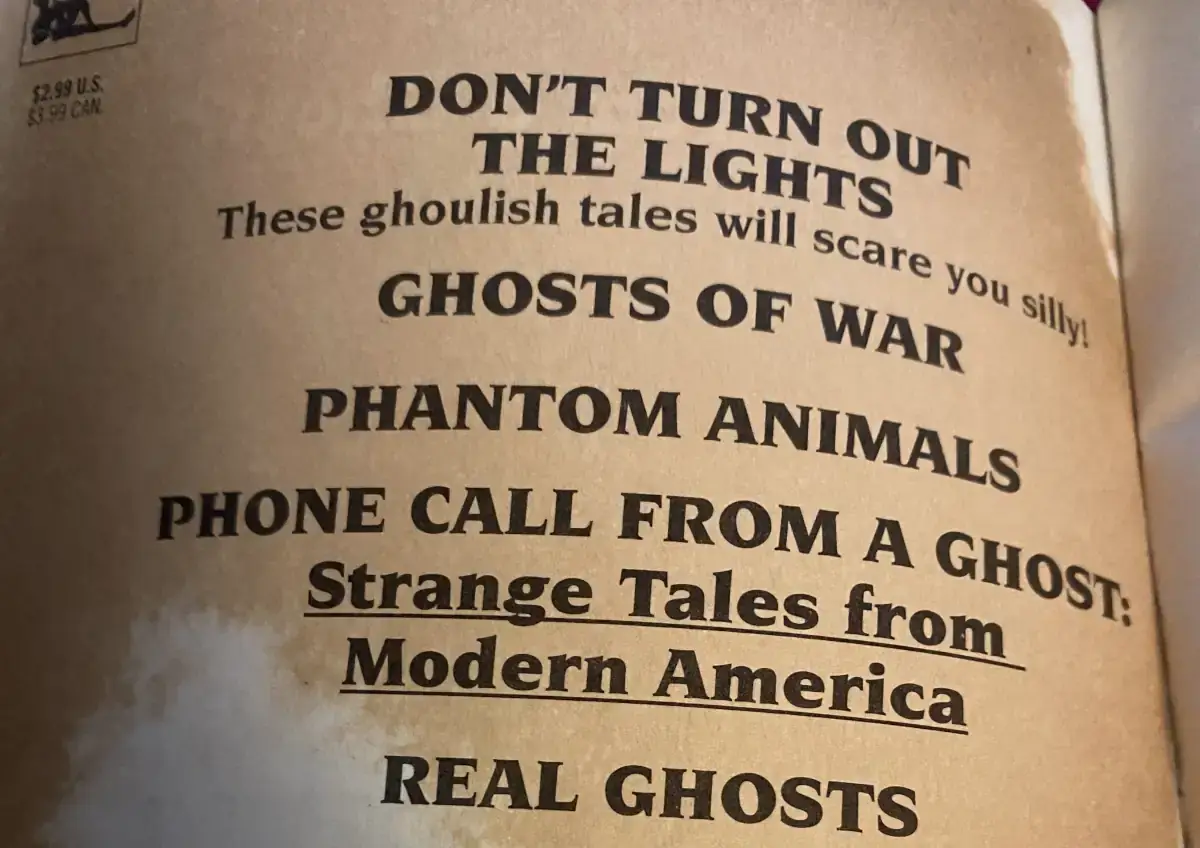
Is Real Ghosts a good book? I think so. You have to remember who these books were for and when they came out. 1977? 1992? This was the era of Scary Stories (another classic Scholastic Book Fair pull), well before the Internet and the days of YouTube hoovering up the pop paranormal.
They’re children’s books. The writing is simple and incredibly easy to follow by design. You read them in grade school, and they introduce you to the paranormal and ghost photography and urban legends. Next thing you know, you’re up late at night listening to Coast to Coast AM, and then you start your own paranormal website and, you know, things go from there.
It’s a little unfortunate they’re long out of print.